


Everyone knows the meaning of fornication as a sin of the flesh, the immoral use of the body that commits the sin of lust and violates the virtue of chastity. The human body is not ordered or intended for conjugal acts outside the bond of marriage in the exchange of love between man and woman. Fornication, then, is a use of the body that is contrary to natural law and divine teaching. It not only sins against the virtue of purity, but also ignores the purpose for the union of husband and wife in the procreation of children. However, Saint Augustine also uses the same word to describe sins of the intellect, disordered acts of the mind used perversely in unnatural ways that defy its true purpose: “So the soul commits fornication when she turns away from you [God] and tries to find outside you things which, unless she returns to you, cannot be found in their true and pure state.” Augustine saw with clarity the correspondence between the abuse of the body that wastes itself in loveless acts of pleasure and the perversion of the mind that does not seek the truth but uses vain learning to justify the various falsehoods that rationalize evil.
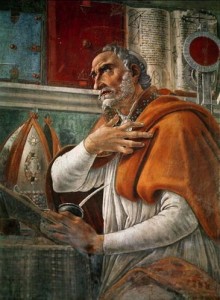 Augustine accuses himself of misusing his mind when he acknowledges, “Allow me, my God, to say something of my intelligence, which was your gift to me, and of how I wasted it on mere stupidities.” Blessed with a gifted mind and the best of classical education, Augustine used his learning to adopt doctrines that absolved him of guilt and distorted the reality of evil. He belonged to the school of the Subverters, thinkers who identified themselves as sophisticated worldly men who mocked modesty, took perverse pleasure in ridiculing others, and flaunted a crude, shameless behavior that Augustine compares to “the behavior of devils.” Their sole object was to attack, destroy, and desecrate the nature of goodness, deriving malicious delight in reducing the good, true, and beautiful to objects of scorn: “ ‘Subverters,’ therefore was therefore a very good name for them. Most clearly they themselves were first subverted and entirely perverted. . .” Instead of the mind conforming to reality and perceiving the beauty of goodness, the mind commits fornication when it calls good evil and evil good in the way the Subverters deride virtue as contemptible.
Augustine joined the fellowship of “the elect” called the Academics who identified wisdom with the philosophy of skepticism: “. . . they held that everything should be considered doubtful and had come to the conclusion that no truth should be comprehended by man.” Despite his study of philosophy and his liberal education, Augustine confesses that he believed “a lot of nonsense” such as holding the view that “a fig wept when it was picked and that the fig tree, its mother, shed milk-white tears.” For all his wide learning in the liberal arts Augustine admits to a superstitious belief in astrology: “The cause of your sin is inevitably determined by the stars,” and “Venus was responsible here, or Saturn or Mars.” He subscribed to the idea of constellations in the heavens foretelling the future until he learned of two children born in the same household at the same time under the exact stars. One child, Firminius, “born to wealth in his father’s house, had one of the brightest careers in life . . . ; whereas the slave had no alleviation in the burden of his condition; he continued to serve his masters.” Augustine condemned his infatuation with astrology as “impious ravings” and “a ridiculous waste of time.” When the mind prefers the darkness of superstition to the light of reason, it perverts intelligence.
Augustine cites another example of the prostitution of the mind in his affiliation with the Manichaean sect. He explains that the dualistic doctrine of “two wills” or two natures both coexisting in man and “struggling inside him” for domination conveniently absolves man again of guilt or responsibility for evil. Man can attribute his vices to the god of darkness that contends with the god of light in the soul of man. How, Augustine asks, does common sense accept such a preposterous doctrine: “For if there are as many contrary natures as there are conflicting wills, we shall find that there are not two only, but many more.” The mind fornicates when it stoops to invent philosophies or ideologies to pander to its desires rather than lift the intelligence to contemplate the grandeur of the truth in its universal, eternal state.
The fornication of the mind, then, abuses the purpose of intelligence. Man’s godlike reason is intended to discover, know, and love truth, goodness, and beauty—not mock it like the Subverters. The mind is designed to comprehend reality by an understanding of natural law, scientific evidence, and logic—not to misread it by the superstition of astrology or the attribution of human life to fig trees. In Aristotle’s famous statement, man by nature desires to know, not to doubt like the skeptical Academics for whom truth does not exist. Common sense and human experience inform all persons that they determine their fate by free will and moral choice and are not ruled by the dark forces, black magic, or demons of darkness. All these corruptions of the mind in Augustine’s intellectual life have their counterparts in the modern culture of death.
Augustine writes of the Subverters that “Nothing can be more like the behavior of devils” than their attacks upon sexual morality and their perverse pleasure in mocking purity.” This attack upon chastity forms the agenda of Planned Parenthood’s sexual education program, the indoctrination in public schools that robs the young of innocence and initiates them into the promiscuous, contraceptive way of life. The Academics whom Augustine called the sophisticated “Elect” who doubted the existence of truth have their modern heirs who regard all truth as relative knowledge, religious opinion, or intolerant extremism. Not even the violence of partial birth abortion procedures, the agonizing pain of children reacting to the abortionist’s instruments of attack, or the dismemberment of children in the womb troubles the Academics who claim not to know when life begins. The astrologers and the Manicheans who adopt the doctrine of determinism to rationalize evil and eliminate human responsibility have their modern apologists who seek hereditary and genetic explanations for advocating same-sex unions. Court decisions that ignore the traditional meaning of marriage and resort to legalisms like “unconstitutional” and “equality under the law” ignore the self-evident truths of common sense as much as Augustine’s belief that fig trees wept.
The mind is not ordered to invent lies, justify immorality, twist the truth, or weave tortured arguments on behalf of evil any more than the body is created for lust, adultery, or prostitution. All the evils of the Sexual Revolution have been legalized and made customary and popular by an educated class of lawmakers, scientists, professors, and writers who have been as guilty of the misuse of education and the abuse of the mind as the intellectuals from whom Augustine learned subversion, skepticism, superstition, and determinism—the many ways he committed fornication with the mind to justify sin, absolve guilt, and rationalize evil. No one can live an impure life without suffering the consequences of a darkened intellect. No one can fornicate with the mind without also living an immoral life.
 Mitchell Kalpakgian, Ph.D. has completed fifty years of teaching beginning as a teaching assistant at the University of Kansas, continuing as a professor of English at Simpson College in Iowa for thirty-one years, and recently teaching part-time at various schools and college in New Hampshire. As well as contributing to a number of publications, he has published seven books: The Marvelous in Fielding’s Novels, The Mysteries of Life in Children’s Literature, The Lost Arts of Modern Civilization, An Armenian Family Reunion (a collection of short stories), Modern Manners: The Poetry of Conduct and The Virtue of Civility, and The Virtues We Need Again. He has designed homeschooling literature courses for Seton Home School, and he also teaches online courses for Queen of Heaven Academy and part-time for Northeast Catholic College.


