


When I was in college, I went through a period of time when I disagreed with some of the teachings of the Catholic Church. I would tell my mother, “I don’t agree with that” or “just because I’m Catholic doesn’t mean I’m on board with everything the Church teaches!” I was a child of the 60s after all; protesting was the custom of the day. One of the concepts of the Catholic Church that showed up on my list was the notion of Purgatory. I did not believe that the Purgatory concept was real. I believed that God was so full of love for us, anything we did was forgivable and we would automatically be sent to heaven. The Catholic Church had other ideas. She teaches that when we die, our souls are judged immediately by Jesus Christ in what’s called the “Particular Judgment.”
Each man receives his eternal retribution in his immortal soul at the very moment of his death, in a particular judgement that refers his life to Christ: either entrance into the blessedness of heaven – through a purification or immediately, – or immediate and everlasting damnation. All who die in God’s grace, but still imperfectly purified, are indeed assured of their eternal salvation but after death they undergo purification, so as to achieve the holiness necessary to enter the joy of heaven (Catechism, 1022 & 1030).
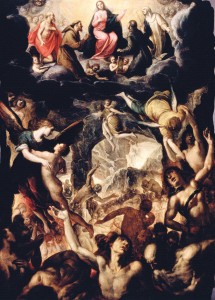 In the month of November, Catholics celebrate All Saints Day, recognizing the lives of those who have been made perfect through the grace of God. But on All Souls Day we remember and pray for the souls of the departed who are completing their pilgrimage of grace in Purgatory.
Many of the Protestant denominations whole-heartedly disagree with this entire concept of Purgatory. They feel if you are a Christian and accept Jesus Christ completely in your heart you will go immediately into heaven. Hell would be the only other option that would result for those who knowingly chose not to accept Jesus in their hearts. Most importantly, they believe there are no Biblical references to the idea of Purgatory. Therefore, it’s just not real. It’s just another Catholic notion! Your options at death are Heaven or Hell. No other choice.
Father Dwight Longenecker states that “Purgatory is a time of purification. In purgatory the souls are joyful because they are all helping one another climb the mountain. There are pains in purgatory, but those pains are connected with the purification that is taking place as the pains are endured. The pains are like those endured by an athlete or an artist in quest of perfection. A pianist must learn to read music and practice every day. An athlete must discipline his body, suffer defeat and failure and refine his talent, hone his skill, practice constantly, overcome his weaknesses to win the trophy. Furthermore, the triumph of the trophy, the joy of the masterful music is sweet because of the effort expended.” Longnecker than quotes the Protestant John Calvin when he said, “You cannot get to heaven by good works, but you cannot get to heaven without good works.” Longnecker goes on to say, “In other words, the work we do towards purification in this life and in purgatory on the other side is not our own work, but God’s great work within us. He gives us the grace to grow into the likeness of Christ, but he also gives us the will to engage with that grace and do the hard work of purification. This goal of gaining heaven with Jesus comes with responsibility. We are being held responsible for doing our best to get there.”
Argument after argument from people who disagree with Catholics on purgatory continue to reference the idea that Jesus already suffered and died for our sins and all we need to do is accept this and love Jesus and our path will lead us to heaven.
So, what does my 60s protester mentality say now? I now think the idea of Purgatory is a logical one. I came to the conclusion that it makes sense that we would recognize there is a Heaven, Hell and a cleansing option called purification or Purgatory. It is true, Christ died for our sins. I also believe in my heart that God is perfect love. It is His love that will allow us to be forgiven and join Him in Heaven. Maybe if we thought of Purgatory as the review place where we go over our past transgressions and then are being cleansed of them by blood so we can fully appreciate the sacrifice made by Jesus and the grace that was offered by Jesus as a gift; maybe this would help us have a better understanding of Purgatory. Christ doesn’t offer a way of washing away original sin, because this is what we inherited from Adam. Our responsibility with original sin I think comes from having a “sin nature”. Let’s face it, our nature is to sin even when we say “today I won’t sin”. It makes sense that a cleansing option would be needed. Otherwise, wouldn’t it be true that everyone would go to Hell because I would think very few are without sin at the time of their death. Christ says, “Greater is he who is in me, then he who is in the world” (John 1 4:4).
As for Biblical references, there are a few. Consider: “But nothing unclean shall enter heaven.” (Rev. 21:27) and “You (God), are of purer eyes than to behold evil and cannot look on wrong” (Habbakuk, 1:13).
Tim Staples says that the Protestant believes Purgatory represents “a medieval invention nowhere to be found in the Bible. It’s a denial of the sufficiency of Christ’s sacrifice.” Catholics acknowledge that Jesus Christ suffered and died so our sins may be forgiven. There is no argument here. As Shari Abbot say, “The truth is: both the works of the individual and the individual will go through the cleansing ‘fire’ described by St. Paul in order that “he” might finally be saved and enter into the joy of the Lord.” Sounds a little bit like Purgatory.
Padre Pio, a friar, a priest, a stigmatic and a mystic of the Catholic Church’s order of Friars Minor Capuchin became famous for having apparitions and bearing the stigmata throughout much of his life. He said, “I believe that not a great number of souls go to Hell. God loves us so much. He formed us at his image. God loves us beyond understanding. It is my belief that when we have passed from the consciousness of the world and when we appear to be dead, God before He judges us, will give us a chance to see and understand what sin really is. And if we understand it properly, how could we fail to do anything other than repent?” One other time someone asked him how Purgatory could be avoided and he replied: “By accepting everything from God’s hand. Offering everything up to him with love and thanksgiving which will then enable us to pass from our deathbed to paradise.”
The argument is not whether Purgatory exists, it’s whether our path to Heaven will be attainable even though we are sinners. I always go back to the idea of prayer. At the core of the answer to most of these questions I believe is prayer. Because it is through prayer that any soul will be allowed to go to Heaven. As my mother would remind us, be sure and pray for the “poor souls in Purgatory at Mass today.” I think that we have the responsibility to pray for souls that are trying to achieve the grace necessary to see God. It looks like I’ve come a long way from the 60s!
 Catherine Mendenhall-Baugh (Cathy) completed her education at the University of Nebraska majoring in Special Education and minoring in English Literature and now works in the insurance industry. A mother and a grandmother, Cathy grew up in a large Catholic family and as spent the last 30 years as a caregiver for her husband, Jack. A writer for Tuscany Press, she is also working on several longer writing projects.


