


The seventh of October is the feast of “Our Lady of the Rosary,” formerly known as “Our Lady of Victory.” It is well to recall how and why this feast was instituted and see how the events connected with its founding still have resonance today for Christian men and women. On 7 October 1571, the Christian Navy of the Holy League met in pitched combat the naval forces of the Ottoman Turkish emperor Selim II, for control of the Mediterranean Sea. It is no exaggeration to say that the fate of Europe and of Christendom was in the balance, and the battle itself has been called one the most significant naval engagements in history.
For 300 years the Ottoman Turks had been expanding their empire from central Asia into the Middle East and Europe. They had succeeded the Arab Islamic empires, imposing their rule from Africa to Iran. In 1453 they had taken the great Christian city of Istanbul, turned its great Hagia Sophia into a mosque, opened a slave market, and then turned their sights on Europe. Their chief soldiers, the Janissaries, were kidnapped sons of Christian families, raised as Muslims and sent to fight as the vanguard of the Turkish army. In 1480 Mehmed the Conqueror’s army had reached Italy, sacking Otranto, killing 8,000 people, and sawing its bishop in half. In the 1520s, Suleiman the Magnificent conquered most of the Balkans, drove the Knights of St. John from Rhodes, and launched a huge invasion that threatened Vienna in 1529, before being driven back. Suleiman’s son, Selim II — called the Drunkard — was not as honorable or well respected as his father. His commanders tricked Cyprus into surrender, then sold all the women and children into slavery (a favorite Ottoman tactic), and then flayed the Venetian commanders, mounting the bodies to their warship’s hulls. With 37,000 Christian slaves manning the oars of their fleet, the empire of the Crescent was ready to attack. The way was open for an invasion of Europe, now riven and divided by the religious conflict of the Protestant Reformation.
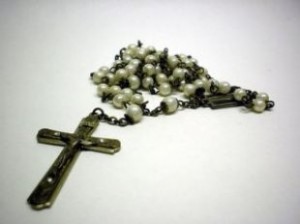 Only Spain had the power to stand against the Turks. All Christendom knew what was at stake, but the Protestants refused to negotiate a defense of Europe. It was left to the Pope, Spain, and the maritime Republics of Italy to mount a response. Led by Don Juan of Austria, the Christians met the Ottomans in battle near Greece and, with a loss of only 20 ships, destroyed 210 of the enemy. Like latter-day Spartans, men of the West had once again saved Christendom and western civilization. The Christian captives were freed, and the Ottomans (though they would menace Europe till the 1680s) never again mounted a naval offensive. In thanksgiving St. Pius V instituted the great feast of Our Lady of Victory, won through the heroism of Christian men and the power of the rosary.
Christendom has always needed defenders. The horror of an Ottoman victory would have seen repetitions of Cyprus and Otranto all along the Mediterranean. We must remind ourselves of the virile Christianity of our forebears, who gave so much that we might inherit the great tradition of the Church and of the West. We must again sing songs to honor those who bore weapons of defense, that we might have peace. One should read G. K. Chesterton’s stirring Lepanto on the feast itself in order to capture what our sentiments should be.
We have done so much in the last 50 years to rediscover authentic Christian feminism, to celebrate “feminine genius,” and rightly so. Without women there would be no culture at all, they are the heart and bearers of culture. Pius V’s hallowing of the victory as a Marian feast makes this plain. I will venture to make one of the broadest generalizations you will hear today. If women are the heart and bearers of culture, then men are its elaborators and defenders. Today this “masculine genius” has been lost in many versions of contemporary Christianity. If we are truly to have the complementarity so vigorously called for by Bl. John Paul II, it cannot be an either/or dichotomy. Young men, so often abandoned by our system and our society, need once again to hear stories like the salvation of Christendom at Lepanto. They need to hear the positive Christian message about those who serve in the military and in public life (Luke 3:14, Matthew 8:5-13, and Acts 10). They need to know both the heroism that turns the other cheek, together with the knowledge that I cannot turn anyone else’s cheek for them. This is the message of sacrificial headship (Ephesians 5:23-29). If the weak are oppressed, they need defense. If there are malefactors, then one can bear the sword of the state against them (Romans 13:4). The defense of the weak and the oppressed is the holy Christian duty of the strong. It is the antidote to Nietzsche, and the cure for the genderless pseudo-philosophies of post-modernity. It is something to be celebrated, especially for boys and young men; it is a path to holiness, and the key to the flowering of a new Christian chivalry for our contemporary times.

Donald S. Prudlo is Associate Professor of Ancient and Medieval History at Jacksonville State University in Alabama. He is also Assistant Professor of Theology and Church History at the Notre Dame Graduate School of Christendom College. His specialty is Saints and Sainthood in the Christian Tradition, and he is the author of The Martyred Inquisitor: The Life and Cult of Peter of Verona (+1252) (Ashgate, 2008) and has recently edited The Origin, Development, and Refinement of Medieval Religious Mendicancies (Brill, 2011).


