


“It is not only that in generalized opinion these attacks tend no longer to be considered as “crimes”, paradoxically they assume the nature of “rights”, to the point that the State is called upon to give them legal recognition and to make them available through the free services of health care personnel. Such attacks strike human life at the time of its greatest frailty, when it lacks any means of self-defence. Even more serious is the fact that, most often, those attacks are carried out in the very heart of and with the complicity of the family—the family which by its nature is called to be the ‘sanctuary of life’” (no. 11). — John Paul II, Evangelium Vitae, March 25, 1995.
When one re-reads Blessed Pope John Paul II’s encyclical on life, he needs to keep these statistics in mind: Since 1980, some 1,295,830,000 abortions were performed throughout the world. That is about one-seventh of the present world population.
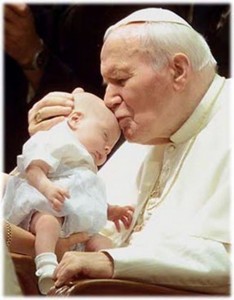 In this context, the famous phrase, “I feel lucky just to be alive!” takes on new meaning. The number of abortions per year in the world is between forty and fifty million. That is, in six or seven years, we kill roughly the population of the United States. Since Roe v. Wade (1973), some 56 million abortions took place in America.
Two sorts of reaction to such numbers occur. One is of horror and sadness that the human race, with so little stir, could allow and even approve this holocaust.
The other is that this massive killing is what human beings “do,” so it must be all right, a part of their nature throughout the world. We have too many human beings for the planet to support anyhow. The sooner we rid ourselves of any notion that we cannot eliminate those unwanted elements in the human race politically judged to be unwanted or unnecessary the better.
John Paul’s Evangelium vitae (The Gospel of Life) is a long, closely argued, and frank statement of the Church’s position on issues of human life. To show how quickly moral levels can decline, the notion of “gay marriage” is not much mentioned in this encyclical.
This further step in the unraveling of the essence of the family was in fact an odd device. It was originally devised by gay apologists, by imitating real family stability, to reduce the well-documented promiscuity of active homosexuals. Only later did it turn into a handy crusade to obtain all the legal and economic benefits of what marriage is, but without any foundation in its actuality. So-called “gay-marriages” are not and cannot be what a marriage is. To use the term “marriage” of both is simply equivocation; the one has nothing to do with the other except as a lie or parody.
This encyclical covers all the bases. It deals frankly with all the facts and theories that are used to justify the “culture of death.” John Paul reaffirms, with all the authority of the papacy and the bishops, that abortion, euthanasia, and directly participating in them are immoral, always and everywhere, even when they are called “rights.”
The encyclical also gives a good run-down of the many causes why these aberrations have come about. It shows compassion for the victims, especially the women and children. The former Pontiff has a whole treatment of the way “life” is used in both the Old and New Testaments. It reestablishes the fact that life itself has its ultimate beginning in the God-head. Each human being, whether aborted or not, has its origin in the gratuity of God. Everyone receives life as a gift, not a “right.” Human beings do not make men to be men, to be what they are.
Human beings are the only ones in creation who are created for their own sakes. This means that they are ordered to eternal life. Life is the good that is the basis of all other levels of life. We are given life that we know and ultimately choose to receive the gift of eternal life that we are granted in conception.
Human life begins at conception. No one can doubt the evidence. Thus, the atmosphere surrounding conception ought to be one that aims to guarantee the dignity of what is conceived by man and woman.
The Church thinks in exactly the opposite manner to the culture. She does not begin thinking of individual “rights.” It begins with the child and its dignity; what it needs. What it needs most are responsible parents who love one another and who will, out of love and generosity, not justice, provide for it by raising it in a manner fit for a human being.
No single person, male or female, has a “right” to a child. What a person has is the freedom to marry, taking into account a proper understanding of marriage, and the responsibility of accepting and caring for what is born of the union.
In reading this document, one is struck by its revolutionary newness precisely because it is loyal to the classical understanding of marriage and children. One can say that, in a worthy human society, no abortions would happen. But this would require a reorganization of almost every institution we know, many of which are proposed and established because human things go wrong.
Of course, the Church understands that we are sinners, too often, alas. Thus, the Church in many areas has taken the lead in providing for human aberration—hospitals, orphanages, AID centers, and counseling centers for women. Many of these have been secularized and often corrupted by the State.
John Paul II was well aware of the impact of the State and politicians in this process. Indeed, his harshest words are often for them, and rightly so. But if the world is brave enough to look at how human life and families ought to exist and flourish, Evangelium vitae is the place to begin.
 Fr. James V. Schall, S.J., taught political science at Georgetown University for many years. His latest book, The Mind That Is Catholic, is published by Catholic University of America Press. His forthcoming book Remembering Belloc will be available from St. Augustine Press in the spring of 2013.


