


On the first day of the calendar year, the Church rightly celebrates Mary, Mother of God, the Theotokos, the one who bore God. This feast, still within the octave of Christmas, points us toward and not away from Christ, whose birth we celebrated only a week ago, for Mary always points us back to Christ. Let us use a homily of Pope Emeritus Benedict XVI from this Solemnity in 2013 as a backdrop for our reflections on Mary, the Mother of God.
This feast is a call to contemplate the face of Christ through the eyes of Mary. She reminds us that we are not only called to receive Christ on Christmas, when He is born in the manager, but to receive Him daily in our hearts, through openness to His will and also in the Sacrament of the Eucharist. Mary was always open to receiving Christ, even in the difficulties and sufferings of her life. Benedict points to the many surprising events that occurred around the time of Christ’s birth: the journey from Nazareth to Bethlehem, finding no room at the inn, and giving birth to Christ in a stable. He writes, “In all this, however, Mary remains even tempered, she does not get agitated, she is not overcome by events greater than herself; in silence she considers what happens, keeping it in her mind and heart, and pondering it calmly and serenely.” Why is it that Mary is not troubled by all these events, things that, for many of us, would be a great cause of anxiety and fear? Benedict continues, showing how Mary should be our model: “This is the interior peace which we ought to have amid the sometimes tumultuous and confusing events of history, events whose meaning we often do not grasp and which disconcert us” (emphasis added).
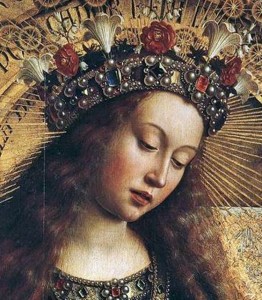 Mary’s life was marked by interior peace, for she placed all her trust and confidence in God. We see this interior peace manifest from the beginning at the Annunciation, for despite her original fear, Mary placed confidence in the words of the angel, “Do not be afraid, Mary, for you have found favor with God” (Luke 1:30). Mary trusted in the Lord’s plan for her, which is how she was able to say, “Behold, I am the handmaid of the Lord; let it be to me according to your word” (Luke 1:38). If Mary did not have an interior peace, a grace given to her by God, would she have been able to say these words? Do we not find that we are more like Martha, who is “anxious and troubled about many things?” (Luke 10:41). Yet Mary, the Blessed Mother, is filled with an interior peace, and she is able to trust fully in God. These words against anxiety are not only the angel’s but also Christ’s, for we read in Matthew’s Gospel, “Do not be anxious about tomorrow, for tomorrow will be anxious for itself,” for the heavenly Father knows all that we need (6:32; 34). Therefore, despite the many trials and tribulations we experience, the dark events of this world, and even the uncertainty of tomorrow, let us remember the interior peace of Mary, who was not anxious, but “kept all these things in her heart,” giving all things over to God (Luke 2:51). Her end was greater than being swept away by transitory, historical events: her end was caught up in the eschatological reality of pursuing the will of the heavenly Father.
But, as we have said, this feast is not strictly about the Blessed Mother. Rather, Mary wishes to point us further than herself to Christ, who is her Son and the Son of the Father. Mary received her interior peace from contemplating the face of Jesus Christ. One can imagine that, in the stable, with the animals surrounding the Holy Family and the shepherds approaching, all Mary could do was adore the face of Christ, for He is truly God Incarnate. For this reason, Benedict writes in his homily, “To rejoice in the splendor of God’s face means penetrating the mystery of his Name made known to us in Jesus, understanding something of his interior life and of his will, so that we can live according to his plan of love for humanity.” When we contemplate the face of Christ, we cry out, “Abba! Father!” (Galatians 4:6). We realize that we are no longer slaves to sin but sons through Christ Jesus, for He came to save us from our fallen human nature. Thus, when we contemplate His face through the eyes of Mary, we see that his “plan of love for humanity” is found in following His will, following in the path of love that He has set before us, which is a plan of self-gift and sacrifice.
The interior peace of Mary, therefore, is her knowledge that she is a child of God and enclosed in the “arms of a loving and all-powerful Father.” Benedict says, “Here is the principle of that profound peace—“peace with God”—which is firmly linked to faith and grace, as Saint Paul tells the Christians of Rome” (cf. Romans 5:1). The Holy Father continues: “Nothing can take this peace from believers, not even the difficulties and sufferings of life.” The reason for this is that peace is not of this world but is founded on our hope in the next, which is why St. Paul continues, “And hope does not disappoint us, because God’s love has been poured into our hearts through the Holy Spirit who has been given to us” (Romans 5:5). Therefore, the interior peace that Mary has comes from her hope in God, which she always had from the beginning when the angel announced the conception of the Holy Child to her.
As we enter this new calendar year, let us frequently recall the interior peace of Mary as she contemplates the Christ Child. Despite the busy and sometimes frantic nature of our lives, let us follow Mary’s example, and pause to adore Christ through the interior peace in her heart. Mary is always pointing us closer to her Son, and so through this interior peace, we will remember that we are no longer slaves to this world but sons and heirs of the Kingdom of God, in which we shall have “peace with God” (Romans 5:1).
 Veronica Arntz is a senior at Wyoming Catholic College, located in Lander, WY. The rigorous Classical curriculum includes courses in humanities, theology, philosophy, rhetoric, Latin, mathematics, and an added emphasis in outdoor leadership. Ms. Arntz recently interned with the Diocese of Madison in the Marriage and Family Department and with Vigil for Life of Madison.


