


John Paul II was not four years into his pontificate when I was born. My experience of Catholicism has been inseparable from his presence as the tender father of my generation – the one who loved our lives better than we ourselves did, who showed us that we were made of better stuff than we knew.
Yet there is another factor to the immense impact he has had on my life.
My father came to the United States as a child, the son of immigrants who fled Communist Czechoslovakia. They were contemporaries of the pope whose faith was forged against first the Nazi and then the Soviet choke hold on Eastern Europe. My grandfather, a twenty-four-year-old underground courier for Catholic priests, was warned by a friend one day to leave the country at once. He said goodbye to no one. In a letter his mother later wrote to him, she said that she remembered looking down from a window that day, watching him walk away with a bundle clutched under his arm, wondering if she would ever see him again. She did not.
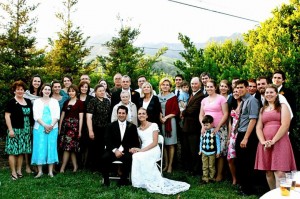
The Krestyn family at a recent family member’s wedding. The author’s grandmother, Hilda, is pictured behind the groom and the author is second from the left.
My grandmother crossed the border into Austria with a group of fellow nurses from the University Hospital in Prague. She survived sweaty-palmed moments of near-discovery, waiting beneath the scrutiny of a Russian soldier while he examined false papers before she could cross the bridge over the Danube from the Russian to the American side. Once they had crossed, the priest helping them told them: “Now are free. You have no place to go, no food to eat. But you are free.”
My father is the son of this moment of horror for his people. As his children, my siblings and I have not escaped some share in the same legacy. In a very concrete and traceable way, our existence has been dramatically affected by the same devastating regime that shaped Karol Wojtyla’s.
While not without joy, my family’s life has been pervaded by the sadness of personal freedoms torn apart. My grandparents suffered the common fate of their generation: their right to dream was driven out. They came to a better place, but the wounds smarted still, and made themselves keenly felt in the lives of their children. Those children never forgot their pained origins. Torn between two worlds, their lives were a study in the search for belonging. My father did not suffer the same traumatic upheaval experienced by my grandparents. He lived nearly his whole life in the United States. But in many ways, his life too has been burdened by this dark history.
His own children, though, have had something he did not. We grew up in the embrace of John Paul II.
I am only half Czech, and have lived my whole life in the United States, so it might be argued that I bear only half the burden of that people’s recent history, if any at all. I never walked barefoot to school, never whispered my prayers in the dark, afraid to speak them aloud. I never knew these deprivations of my grandparents, or felt their effects as my father did. But perhaps none of that would have been enough, had it not been for John Paul II.
I found myself at age 25, the embodiment of my generation’s ambivalence toward life: Who was I? Did I have what it took to be a grown up? Was I capable of committing to a person, a job, anything? Was it right for me to seek happiness? Or was it an exercise in futility, destined to end in bitterness? Did God really love me? Could anyone?
These doubts had always been lurking within, but now aggravated by the demands of growing up, they reached a pitch of panic. I began to feel entirely unequal to the challenge, and though I knew there were people in the world who loved me, I felt that somehow they could not help me in this.
I took my dream trip to Europe in the midst of this torment, clinging to my faith as my link to sanity. But, at some point, weary, I openly questioned whether my faith had the answers I needed. Was it not failing me now? I trudged the road to Lourdes, stood in St. Peter’s Square, crying out. My tears have been my food day and night/While they say to me all day long, “Where is your God?” This was my cry in those days. It was a cry I had felt in some form all my life. It was the cry of Poland, of Czechoslovakia, in those days not so long ago.
I grew up in California, in a small town, riding my bike around the block and eating ice cream in the backyard. But my cry was the same cry. I was begging for an identity.
Somewhere along the way, in Italy, I walked into an American bookstore and went in search of something to soothe my soul. Running my hand across a dozen titles, almost subconsciously I went for a coffee table book full of photos of John Paul II. He had died only two years before.
I had every reason to hope that the pope could comfort me when no one and nothing else seemed able to. More than anyone I knew, he walked the walk as much as he talked the talk.
And yet, it wasn’t reason that moved me in those moments in the bookstore in as I sat there, distressed beyond my own understanding. I felt then, as never before, close to rejecting my faith. But, as I looked at the image of the pope, the sheer fact of him stayed the chaos inside me. His heart, through the glossy page, corresponded to mine. Looking at him, I knew that questions in the face of the terrible mystery of his life must sometimes have seemed to overwhelm him. A temptation to submit to bondage must sometimes have seemed the most reasonable route.
But I felt his words, rising from the page, striking at the depth of my sadness, cracking it apart: “You are not the sum of your weaknesses and failures. You are the sum of God’s love for you.”
Those words, accompanied by images of a man who had suffered at the hands of the same evil my family suffered, told me that the deepest and most lasting thing is joy. “Do not weep. I am happy and you should be happy too. Let us pray together with joy.”
When, when I was dying for the lack of an experience of the things it promised, I found it in that face, those eyes, that voice. It reached down over my distress, the hand of Jesus in the hand of that man. A searcher, I discovered that I was sought.
JP II himself defined this experience as the origin of every person’s journey in faith: It is Jesus who takes the initiative. When we involve ourselves in the question of Christ, the question is always turned upside down: from questioners, we become questioned; searchers, we discover that we are sought. He, indeed, has always loved us first. This is the fundamental dimension of the encounter: we are not dealing with something, but with Someone, with the Living One.
John Paul II gave to me the capacity to recognize that Christ is real and has conquered death, not because I say it, but because I can recognize Him in reality. I recognized Him in that look, the look that liberates.
I look back now, from a point on a road that has brought me far from that moment in the American bookstore in Milan, and I know where my help has been from. To tell the many proofs of John Paul’s hand in the concrete realities of my life would require more words than I have now.
Some have been small, such as the moment I got a call from a woman I had recently asked John Paul to help me become a better friend to; she called to tell me I had inadvertently dropped a tiny rosary blessed by the pope, and with an image of him on it, outside her door. Or when my godmother suffered a botched thyroid surgery, and I prayed a novena to the pope for the success of her corrective surgery, which happened to take place on April 2, the anniversary of his death.
“Like” Truth and Charity Forum on Facebook!
Some of these proofs have been bigger, from the mystical young Polish priest I found in my own hometown parish after begging John Paul’s intercession to find me a spiritual director, to the marriage of my beloved sister, on the eve of the Feast of Divine Mercy three years ago.
These proofs have been too many and too striking for me not to see John Paul’s unmistakable mark on my life and the life of my whole family, stretching back from my generation to that of my grandparents. It is a mark on lives that have at times seemed too mysteriously painful to accept.
If he has shown me one thing, it is to have faith and to fight for the freedom to live it.
I think it was his conviction that my generation would give back to our fathers the hope that was torn away from their young hearts by the violence of false ideologies. I think he trusted that we would look at our fathers and say what he said: “If time marches on inexorably, often shattering even our dreams, Christ, the Lord of time, gives us the possibility of an ever new life.”
That torn-away hope waits for them and all whose faith falters; it is their birthright, their inheritance.
 Anna Krestyn is a freelance writer and Director of Religious Education at St. Lawrence the Martyr Catholic Church in Alexandria, VA. She graduated with a Bachelor of Arts in liberal arts from Thomas Aquinas College and worked as a publishing assistant at Catholic Answers in her native California before moving to northern Virginia to pursue pastoral work.


