


The World Day of the Sick, instituted by Saint John Paul II in 1992, takes place annually on February 11, the Feast of Our Lady of Lourdes. During this Extraordinary Jubilee Year of Mercy when the World Day of the Sick will be solemnly celebrated in the Holy Land, Pope Francis has chosen for its theme Entrusting Oneself to the Merciful Jesus like Mary: “Do Whatever He Tells You” in which he reflects on the Gospel account of the wedding feast at Cana (John 2:1-11). In his message for the occasion, Pope Francis notes, “Illness, above all grave illness, always places human existence in crisis and brings with it questions that dig deep…In these situations, faith in God is on the one hand tested, yet at the same time can reveal all of its positive resources. Not because faith makes illness, pain, or the questions which they raise disappear, but because it offers a key by which we can discover the deepest meaning of what we are experiencing…” This key, the Holy Father points out, is given to us by Mary, our Mother, who knows what it means to walk with Jesus weighed down by the cross.
Mary is the prime example and model of what it means to trust in God, and she is always pointing us to Jesus, just as she instructed the servants at the wedding feast, “Do whatever He tells you.” As Pope Francis reflects on this passage in light of care for the sick, he says, “Mary’s request at the wedding feast, suggested by the Holy Spirit to her maternal heart, clearly shows not only Jesus’ messianic power but also his mercy…. In Mary’s concern we see reflected the tenderness of God. This same tenderness is present in the lives of all those persons who attend the sick and understand their needs, even the most imperceptible ones, because they look upon them with eyes full of love.”
Mary’s message of “Do whatever He tells you” has many implications and indeed also offers us much consolation. While following Christ can at times be difficult, particularly when we are facing significant challenges that affect our body, mind, and soul, Mary’s own example shows us that when we trust God, we learn that God is trustworthy. Her fiat at the Annunciation demonstrates that even in the midst of many questions and unknowns, her trust in God’s plan for her life, and for our salvation, was fulfilled beyond measure.
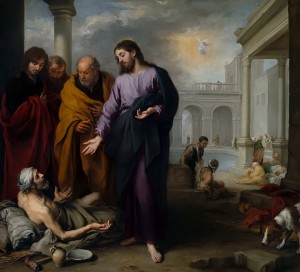
Jesus Himself is the Divine Physician. The miracle at Cana was the first of many miracles in which Jesus showed the presence of God – we see throughout the Gospels how the blind regained sight, the deaf could hear, the lame walked, lepers were cleansed, demons cast out, sins forgiven, and heavy burdens made light. And just as Jesus called His disciples to be servants, starting with stewards at the wedding feast who unhesitatingly and generously followed Jesus’ command to fill the jars with water, Jesus calls us too, to serve and care for the sick with the same faith-filled readiness.
 We live in a world where many try to avoid suffering at all costs. This is especially manifest in the twisted promotion of physician-assisted suicide and euthanasia which has become rampant in our society. The despair which leads people to succumb to this grievous temptation is tragic. Those who approach sickness, suffering, and death with the eyes of faith and love however, have a much different perspective. To always care, even when a cure is not possible, is the hallmark of Catholic healthcare. When a doctor or nurse or any medical professional sees each patient through the eyes of love as a human being with inherent dignity, made God’s image, that in itself can lift a despairing soul into a place of peace and hope.
The work of mercy helps the suffering person to grow in their trust of God. It is in our times of trial and tribulation where the Lord can work powerfully if we let Him. We are made for eternity and embracing the Cross is the road that leads us there. What so many are missing today is an understanding of the redemptive meaning of suffering. Uniting our pain – be it physical, emotional, moral, or spiritual – to the Crucified is truly transformative. Very often those who care for the sick are blessed to see this transformative work of God, as one contemplates the last things and the meaning of life, and realizes his or her total dependence on our Creator, for without Him we can do nothing. It is often in those final moments where forgiveness happens and relationships are healed, bringing peace and communion with the Lord and loved ones. Things work better when we remember that God alone is the author of life and death and we are safe in His hands.
None of us escapes suffering in this life. But we are not alone if we walk through it with God at our side. We know that the Cross is not the end of the story. On the other side of the agony, the pain, and the suffering, is a Risen Lord who wants to raise us up to be united with Him in love for all eternity.
Mary, help of the sick, pray for us!
 Allison LeDoux is the director of the Respect Life Office and the Office of Marriage and Family for the Diocese of Worcester, MA. Mrs. LeDoux serves as coordinator for the New England region of Diocesan Pro-Life Directors and is a member of the Massachusetts Catholic Conference’s Pro-Life/Pro-Family and Health Care Subcommittees. She received her certification in Catholic Health Care Ethics from the National Catholic Bioethics Center in 2007.Mrs. LeDoux and her husband, John, a permanent deacon, are the parents of eight children.


