


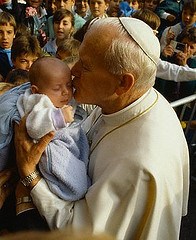
Blessed Pope John Paul II, in his Evangelium vitae, urges us to be on the side of the Culture of Life. We know that pride can blind. The Pharisees, no doubt, believed they were on the right side of the Lord, but they were victims of self-deception. Abortion and euthanasia advocates assert that they have taken the higher moral ground because they are motivated by compassion, mercy, courage, and love.
Are pro-life advocates, then, lacking in virtue? Are they anti-choice and opposed to the rights of women? Pro-life people like to think that they are associated with the Culture of Life. But how can a person be sure that he is working for the Culture of Life and not deceived by his own pride? Both sides claim to be on the side of the angels. Is there an objective way of determining whether one is truly directing his energies for the Culture of Life and not for the Culture of Death?
Evangelium vitae provides an objective test, one that can be analyzed on two different levels: 1) regarding the fruits of one’s actions; 2) regarding the foundation of one’s virtue.
 Blessed John Paul begins the first chapter of Evangelium vitae by recounting Cain’s murder of his brother, Abel. Cain experienced envy and anger toward his sibling, vices that disposed him to murder. Nonetheless, Cain was most reluctant to acknowledge his crime. When God asked him about the fate of Abel, Cain protested, “I do not know; am I my brother’s keeper?” This lie, as Blessed John Paul avers, “was and still is the case, when all kinds of ideologies try to justify and disguise the most atrocious crimes against human beings” (no. 8). Vice begets vice, evil generates more evil. The fruits of an immoral action are more immoral actions.
Abortionists, in the manner of Cain, do not want to acknowledge the nature of their act. Thus, they lie about their victims who are presumed not to be unborn human beings, but “undifferentiated tissue,” “pre-embryos,” “parasites,” “vampires,” or potentialities that belong to no identifiable species. The lie is extended to the adverse effects that abortion inflicts on women.
The late Henry Morgentaler, who was Canada’s leading abortionist, is not embarrassed about grossly misrepresenting the dangers inherent in the abortion procedure and denying irrefutable scientific evidence: “Women no longer die as a result of abortion. Women no longer get cut up or damaged as a result of abortion. Women no longer lose their fertility as a result of abortion.” The lie continues as it disparages pro-life people as being against human rights, as extremists, as unfeeling and as lacking compassion.
On the other hand, being genuinely pro-life sets in motion an order of truth and love that is positive and life-connoting. Sexual intimacy belongs in marriage and is ordered to life, birth, and child-raising. It intensifies the bond between husband and wife.
The family is a school of love and a creative force for society. In fact, the pro-life family is the basic unit of society. Pro-life advocates are unjustly labeled as “hypocrites” when their actions do not serve the cause of life. But in such incidents, such as the killing of an abortionist, the accused are not pro-life, but pro-choice.
It is most telling that when a person takes a page from the pro-choice handbook, he is vilified by the pro-choice advocates themselves. This reveals the duplicity of the pro-choice movement and not the hypocrisy of pro-life advocates. As Rochefoucauld once remarked, “Our virtues are most frequently but vices disguised.”
The Gospel is clear and forthright on the matter: “Every tree that does not bear good fruit is cut down and thrown into the fire. Therefore by their fruits you will know them” (Matthew 7:20).
Blessed John Paul II closes his encyclical with a prayer to Mary in which he entrusts her to the “cause of life.” He implores her help for all those who are victims of “misguided mercy” and to assist those who proclaim the Gospel of life to do so “with honesty and love.”
Advocates of abortion and euthanasia credit themselves with having the virtue of mercy, along with compassion and courage. But what is the foundation of their alleged virtues? Is it convenience, practicality, a loss of hope? Mercy can be misguided just as easily as compassion can be misapplied and courage can be misunderstood.
A miser might count himself frugal, whereas he is uncharitable. A man may boast of having great courage, whereas he is foolhardy. A coward may claim to be prudent, whereas he is overcome by fear. Nothing is easier than to boast of a virtue that one does not possess.
The issue of “counterfeit virtues” has a long history. St. Augustine wrote in his Confessions about those people “readily beguiled with the surface of what was but a shadowy and counterfeit virtue.” For St. Thomas Aquinas, “Love is the form of all virtues.” In his De Caritate, he states that “it is necessary for charity to be a special virtue, distinct from the other virtues, but yet the most important virtue and the mover of the other virtues.”
For Aquinas, love (or charity) is “primary” and “architectonic” with respect to other virtues (Sum. Theol. I-II, a.1, q. 65, ad 2). Simply stated, “Love is the form of all virtues.” A “virtue” loses its claim to virtuousness when it is not grounded in love. The loveless “virtues” are all counterfeit.
Blessed John Paul’s invocation to Mary is anthropologically profound. It conveys the message that a proclaimed virtue may be counterfeit. At the same time, one who claims to be pro-life may be tempted to stray from that ideal. There is a vestige of Cain in each of us, just as there is the presence of God trying to break through to the surface.
A pro-lifer must deal with the temptation to be “pro-choice,” just as pro-choicers must wrestle with the desire to be pro-life. We human beings are cut from the same cloth. The important feature is not the label we place on ourselves and on others, but the integrity by which we live.
A pro-life person should be pro-life in his behavior as well as in his protestations. And this will be manifested through the fruits of his labor as well as in the love that is the foundation of his virtues.
 Dr. Donald DeMarco is a Senior Fellow of Human Life International. He is professor emeritus at St. Jerome’s University in Waterloo, Ontario, an adjunct professor at Holy Apostles College in Cromwell, CT, and a regular columnist for St. Austin Review. His latest works, How to Remain Sane in a World That is Going Mad and Poetry That Enters the Mind and Warms the Heart are available through Amazon.com.
Articles by Don:


